




















































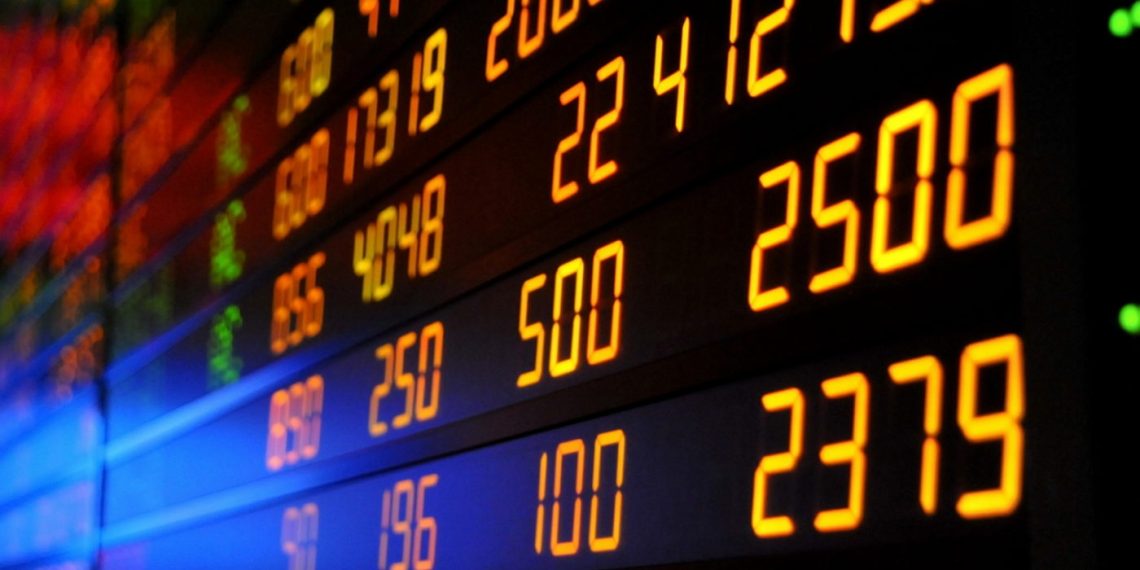
Trading on the Ghana Stock Exchange ended on a strong note on Tuesday, March 3, 2026, with MTN Ghana dominating turnover as sustained buying interest lifted the benchmark indices.
Data from the Ghana Stock Exchange (GSE) showed continued positive momentum, supported by measured gains in selected counters.
The GSE Composite Index (GSE-CI) surged by 384 points to close at 13,734.54, pushing its year-to-date (YTD) return to 56.60 per cent from 52.23 per cent.
The GSE Financial Stocks Index (GSE-FSI) also rose by 427.72 points to 8,495.93, extending its YTD gain to 82.82 per cent.
Market capitalisation climbed to GH¢251.02 billion from GH¢244.52 billion in the previous session marking the first time the Exchange has crossed the GH¢250 billion threshold, equivalent to a quarter of GH¢1 trillion.
Despite the strong rally, trading activity softened. Total volume traded fell by 79.62 per cent to 4.92 million shares, while total value traded declined by 72.18 per cent to GH¢39.30 million.
MTN Ghana led by volume, recording 3.09 million shares worth GH¢17.83 million, accounting for 45.36 per cent of total turnover.
It was followed by Societe Generale Ghana, Enterprise Group and GCB Bank in value traded.
On the gainers’ chart, Standard Chartered Bank Ghana and Enterprise Group led performance.
Standard Chartered Bank Ghana advanced by GH¢4.29 to close at GH¢47.24, while Enterprise Group gained GH¢4.00 to settle at GH¢57.00.
Other stocks posting notable gains included Ecobank Ghana, GOIL, SIC Insurance Company, Unilever Ghana and MTN Ghana. The market recorded no decliners at the close.
Meanwhile, AngloGold Ashanti is expected to pay a Q4 2025 dividend of $1.73 per share on March 27, 2026, while MTN Ghana will pay a final dividend of GH¢0.40 per share for the 2025 financial year on April 10, 2026.
Analysts say sustained foreign participation and targeted accumulation in fundamentally strong equities could continue to support the indices in the near term, barring major macroeconomic shocks.