
























































Luis Rubiales, the former president of Spain’s football federation, is on trial from Monday, accused of sexual assault for kissing player Jenni Hermoso. The case has sparked broader conversations about sexism and consent in sports.
Hermoso, who currently plays club football in Mexico, is set to testify as a witness on the first day of the trial, which will run until February 19.
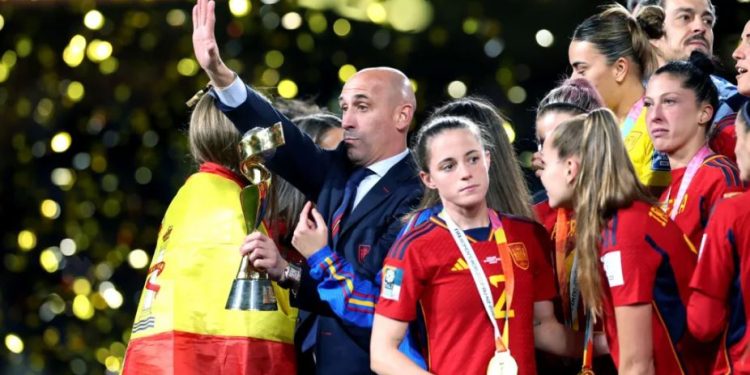
The incident occurred after Spain’s victory over England in the 2023 World Cup final in Sydney. As the players received their medals, Rubiales grabbed Hermoso by the head and kissed her on the lips. Hermoso later stated that the kiss was not consensual, while Rubiales maintained that it was.
The kiss led to widespread protests and demands for Rubiales’s resignation, with the controversy also gaining political attention. Prime Minister Pedro Sánchez, whose government has introduced reforms to promote gender equality and consent in sexual relations, commented that Rubiales’s actions highlighted the ongoing need for progress toward equality and respect between men and women.
After initially remaining defiant and denouncing a witch-hunt driven by “fake feminism”, the federation president eventually resigned, before legal charges were brought against him.
Prosecutors are calling for Rubiales to receive a one-year prison sentence for sexual assault for the kiss. They are also calling for him to be given a sentence of a year-and-a-half for coercion, for allegedly trying to pressure Hermoso into saying publicly that the kiss was consensual. Rubiales denies the charges.
Three colleagues of Rubiales are also on trial, accused of colluding in the alleged coercion: Jorge Vilda, coach of the World Cup-winning side, Rubén Rivera, the federation’s former head of marketing, and former sporting director, Albert Luque. They all deny the charges.
Isabel Fuentes has watched the female national team closely ever since she was among the first women to represent Spain at football, from 1971 onwards. She describes the furore caused by the Rubiales kiss as “very sad”, because of how it overshadowed the World Cup victory, which, when mentioned, brings her to the verge of tears.
“It was something we would have liked to experience, but we weren’t allowed to,” she says. “These players won it for us. They have lived out our dreams.”
Fuentes played when the dictatorship of Francisco Franco was still in place and the women’s team were not even allowed to wear the Spanish flag on their shirts.
“The regime said: ‘We don’t want you to play football, but we’ll just ignore you,’” she says. “And the federation put all manner of obstacles in our way.”
Like many fans, she was concerned by how the Rubiales controversy affected the international image of Spanish football and she was also shocked by footage showing the former federation president celebrating the World Cup win by grabbing his crotch as he stood just a few feet away from Spain’s Queen Letizia.
But younger players, like Belén Peralta, prefer to emphasise how far women’s football has come, rather than dwell on the Rubiales case. Playing for third-division side Olimpia Las Rozas, Peralta says that even in the last few years she has noticed a shift in terms of the attention and support that women’s football receives.
“When I was younger, girls playing football was kind of strange, you were told, ‘Oh, that’s for boys,’ or ‘That’s not a girl’s thing,’” she says. “And nowadays, you go to some places and you say, ‘I’m a footballer,’ and that’s so cool and attractive.”
Her teammate, Andrea Rodríguez, agrees. Although she says that occasionally she might hear sexist comments about women’s football, social attitudes are overwhelmingly positive.
“People are more open-minded now,” she says.