
























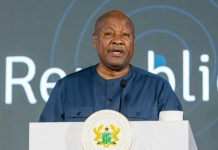


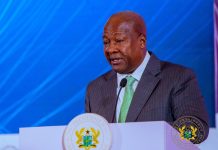
























Dr Theo Acheampong, Technical Advisor at the Ministry of Finance, has highlighted the critical role of the Ghana Gold Board (GoldBod) in channeling additional foreign currency into formal banking channels, a development he says has helped stabilise the Ghanaian cedi.
Dr Acheampong explained that prior to these policy interventions, a significant portion of foreign exchange generated from the artisanal and small-scale mining (ASM) sector did not enter the formal banking system.
“…If you did a proper disaggregation and you did all the sort of analytical work, I would think that the proportion of those hitherto gold dollars from the ASM sector that was coming into the formal banking channels is properly going to be on a scale of 20 or 30 per cent.
“But what is radically different this time is that you are, in essence, through policy, trying to force them to get or bring those dollars into your formal channels via GoldBod and ultimately to the central bank…This is why this is extremely very important.”
Dr Acheampong stressed that the cedi would have been in a much weaker position if Ghana’s stabilisation efforts had relied solely on reforms under the International Monetary Fund (IMF) programme.
He argued that without the GoldBod-linked measures, the exchange rate would not have ended the year around GHS10.45 or GHS10.5, but rather at a significantly weaker level.
“If it was just the IMF reforms, I can tell you that the cedi would have been in a relatively worst shape than we are now. What I mean by that is that your exchange rate would not have ended the year at GHS10.45 or GHS10.5. It may have moved from GHS15 to like GHS13 and this is why this is very important.”
To support his argument, Dr Acheampong cited the IMF’s own assessment of Ghana’s foreign exchange management. According to the Fund, the Bank of Ghana has “taken an increasingly active role as an intermediary in the foreign exchange market, supported by stronger payment inflows.”
“You go to the IMF’s own assessment which buttresses this point. In paragraph 33, it says that ‘the BoG is actively managing the FX market while increasing its footprint. Since programme approval the bank has taken an increasingly active role as an intermediary in the FX market on the back of stronger barns of payment inflows.
“The domestic gold purchase programme has been the key stocks of this inflows which also include cocoa and repatriation and so forth.’”