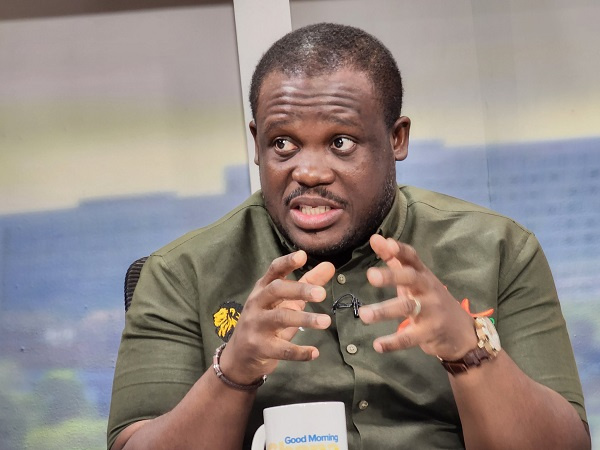








































The Minister for Communication, Digital Technology, and Innovations, Sam George, has engaged broadcasters on a proposed cost-sharing framework for Ghana’s Digital Terrestrial Television (DTT) platform as the government pushes to make the system financially sustainable.
The stakeholder meeting focused on developing a pricing model for channel carriage on the DTT platform, with the Minister assuring industry players that the process would remain transparent and consultative.
Sam George said the introduction of carriage fees was necessary to sustain the platform. He stressed that the government would work with broadcasters to ensure fairness and long-term viability.
He noted that Ghana’s DTT infrastructure has operated for years without meaningful cost recovery, necessitating a pathway to financial sustainability.
According to the Minister, proposals presented at the meeting were intended to guide discussions and help stakeholders reach consensus within set timelines.
The Minister further clarified that the government would take a policy position on key structural issues, including the management of shared infrastructure and cost obligations, in the broader national interest.
He stressed that the DTT platform should not yet be viewed as a profit-making venture but rather as a critical national infrastructure that requires collective support from stakeholders.
Broadcasters who participated in the meeting welcomed the engagement but called for deeper consultation and greater clarity in the formulation of pricing models. They cautioned against decisions that could be perceived as predetermined without adequate industry participation.
Participants also underscored the importance of the DTT platform to the survival of the broadcasting industry, expressing support for reforms aimed at strengthening the system while urging alignment with existing operational realities.
During the meeting, the Ministry presented three pricing models — Case A, Case B, and Case C — following delays linked to committee processes. The government recommended Case C, Scenario 2 as the preferred option.
Committee members, however, raised concerns that it was their first time reviewing the proposals and requested additional time for study and feedback. The Minister agreed to the request but indicated that a final decision on pricing should be reached by May 31 to give broadcasters enough time to prepare.
The meeting also clarified that the annual operational cost of DTT transmission centres stands at $7.25 million, disputing an earlier $11 million estimate reportedly mentioned by K-Net during previous pricing discussions.
Officials disclosed that based on the current number of broadcasters on the platform, about $4.4 million could be recovered under the proposed arrangement, leaving an estimated $3 million funding gap, excluding costs related to Ghana Broadcasting Corporation sites.
Under the preferred Case C, Scenario 2 proposal, each broadcaster would pay $7,445 monthly from January 2027, translating into an annual payment of $89,340, subject to parliamentary approval.
Samuel Nartey George also indicated that the government intends to reduce overall operational costs while working toward full cost recovery. He added that all broadcasters operating on the DTT platform would be required to pay the agreed fees beginning January 2027 once the framework receives parliamentary approval.
The engagement forms part of ongoing efforts by the Ministry to resolve outstanding operational issues surrounding the DTT platform and strengthen Ghana’s digital broadcasting ecosystem.