





















































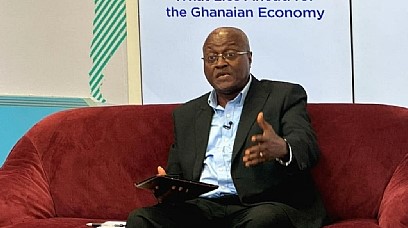
Financial analyst Richmond Atuahene has stated that Ghana’s declining inflation rate has not translated into a lower cost of living for many households, citing lagging purchasing power and deep structural inefficiencies in the economy.
As of March 2026, Ghana’s annual inflation rate eased to 3.2%, continuing a 15-month downward trend and marking its lowest level since 2021.
Although inflation has fallen to its lowest level in years, many consumers say this has not translated into a reduction in their cost of living or improvements in their everyday lives. They note that prices of essentials such as food, transport, fuel, and utilities remain high.
Dr Atuahene said the disconnect between “paper inflation” figures and real household experience stems from the sharp inflation surge in previous years and its delayed impact on the economy.
“There is a lag in the economy, and it is because inflation went to about 54% in 2022. Coming down to 3.3%, there is a delayed effect. This means that the rate at which inflation went up, it doesn’t come down to the same level,” he said.
He argued that incomes have not kept pace with price movements, thereby eroding the purchasing power of the average Ghanaian.
“That is why once incomes lag behind, the purchasing power comes down… it has eroded the purchasing power of the average Ghanaian. No matter the inflation figures you see, you have forgotten that whatever savings you had would have possibly run into the negative,” he said.
Dr Atuahene also pointed to long-standing structural challenges, including poor transport infrastructure and inefficient logistics systems, as key drivers of persistently high prices.
“Someone cultivating tomatoes or yams in a rural area could have delivered this food to Accra within five hours. Today, it will take more than 10 hours to bring tomatoes from Kete Krachi to Accra,” he said.
He added that inefficiencies in road networks and the absence of a reliable railway system continue to push up prices, even when inflation appears stable.
“In countries where they have solved these structural issues, inflation and the cost of living are better than what we have,” he said.
“Even if inflation is zero and you produce in my village, by the time it gets to Accra, transport and wastage alone can affect prices,” he added.